The Grand Inquisitor
The Brothers KaramazovThe Grand Inquisitor is the nearly ninety-year-old cardinal in Ivan’s tale of Christ’s return to Seville during the Inquisition. He embodies a claim that institutional authority can relieve humanity of freedom and its burdens by ruling in the name of happiness; when Christ stands before him, however, the cardinal’s elaborate defense of that power meets an answer of silence.
Identity and Appearance
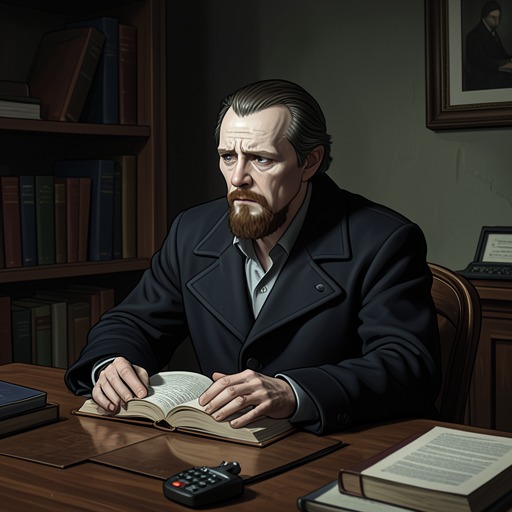
The cardinal appears as a tall, erect old man, his face withered and his eyes sunken, though a gleam of light remains in them. He passes the cathedral amid cries, sobbing, and confusion. Unlike the preceding day, when he had worn the splendid robes associated with burning the enemies of the Roman Church, he is not dressed in those gorgeous vestments at the moment of the encounter. The contrast joins the spectacle of ecclesiastical power to the diminished, still commanding figure who speaks for it.
The Claim to Make Humanity Happy
The Inquisitor presents the defeat of freedom as an achievement. He claims that the Church has vanquished human freedom so that people may be happy, arguing that humanity was created rebellious and therefore cannot be happy while bearing the demands of independent choice. In his account, the Church takes responsibility for governing those whom freedom leaves burdened and unhappy. The argument recasts control as mercy: authority is justified not as domination for its own sake, but as a means of securing human well-being.
The speech also assigns responsibility for this order to Christ. The cardinal tells Him that He laid the foundation for the destruction of His kingdom and is therefore more to blame than anyone else. This reversal lets the Inquisitor present the Church’s coercive settlement as a response to a crisis Christ created: people, he maintains, cannot sustain the freedom they were given. His indictment thus turns a dispute about institutional power into a dispute about what human beings can bear.
Encounter with Christ
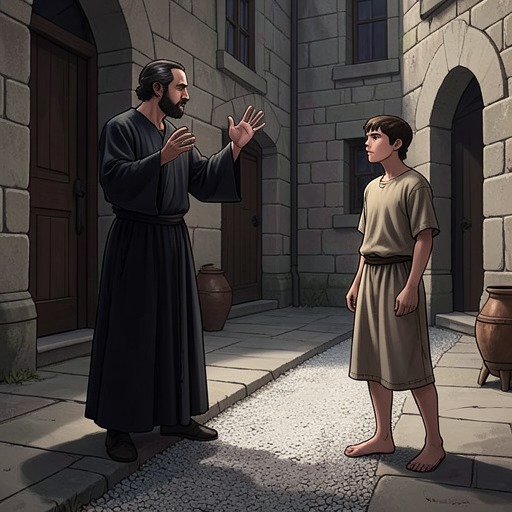
When Christ stands before him, the Inquisitor gazes into His face for a minute or two. He then sets a light on the table and speaks, opening with the question, “‘Is it Thou? Thou?’” But he does not wait for an answer. He immediately tells Christ not to answer, insisting that He has no right to add anything to what He said of old. The cardinal seeks to control not only the conditions of human freedom but also the terms on which Christ may speak.
Christ’s silence leaves the Inquisitor’s long accusation unanswered in words, but it does not turn the encounter into an ordinary debate. The cardinal can explain and defend the Church’s power; Christ does not accept the premise that the encounter must be settled by argument on the Inquisitor’s terms. The withheld reply makes their opposition especially stark: one figure speaks for authority that promises happiness through the conquest of freedom, while the other’s presence resists that settlement without offering a counter-program in speech.
Narrative and Thematic Role
As a character in Ivan’s embedded story, the Inquisitor gives dramatic form to the conflict between freedom and security, and between religious authority and the claims of Christ. His reasoning is not a passing accusation: he claims the Church has already made happiness possible by overcoming freedom, and he holds Christ responsible for the human difficulty that supposedly made such rule necessary. The tension lies in the gap between the promised happiness and the means used to secure it.
The cathedral scene places the Inquisitor amid public cries and confusion, then narrows the action to his gaze, the light he sets on the table, and his demand for silence. That movement from tumult to a private confrontation concentrates the tale’s central contest in a single exchange: the institution’s representative insists on the authority to speak for humanity, while Christ’s silence leaves the Inquisitor’s claimed victory open to judgment.